Mountain Biking story
Gobi Desert Mountain Bike Tour Mongolia 2026 – 345 km Across the Wild Gobi
· Mongolia Expeditions

Ride 345 km across Mongolia’s Gobi Desert with Mongolia Expeditions, from Khongoryn Els and Arts Bogd to the dinosaur sites of Tugrugiin Shiree and Bayanzag.
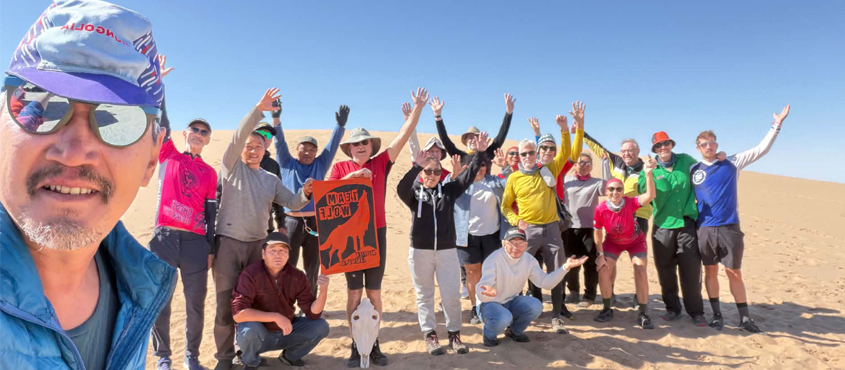
From September 16–25, 2026, our long-time friends and returning guests, Wolf Team, came back for their 11th adventure with Mongolia Expeditions. This time, the group of 12 took on a very different challenge – a 345 km Gobi Desert mountain bike tour across southern Mongolia, riding through remote mountain valleys, sand dunes, desert oases and some of the most important dinosaur fossil sites in the world.
The goal of this journey was not simply to cover distance. We wanted to create a true Mongolia mountain bike adventure, staying away from the main tourist roads whenever possible and connecting some of the Gobi’s most remarkable landscapes by bike.
Our journey began with a flight from Ulaanbaatar to Dalanzadgad in South Gobi Province. From there, we drove about 70 km into the Gurvan Saikhan Mountains to reach the remote Shavart Valley below Dund Saikhan Mountain. Surrounded by mountains and open desert, we unloaded our bikes and began our journey across the Gobi.
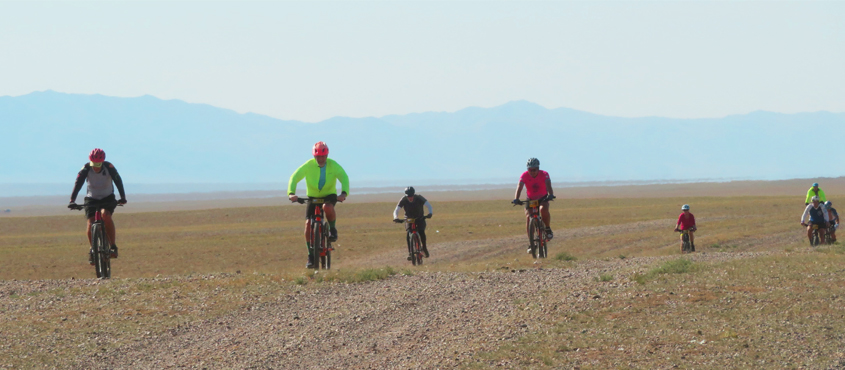
Over the next three days, we rode approximately 150 km from Shavart Valley through the Dund Saikhan region toward the great dunes of Khongoryn Els. This is one of our favorite sections for mountain biking in Mongolia. Rather than following the busy vehicle tracks used by most visitors, our route crossed isolated valleys, open plains and remote desert tracks beneath the Gobi Altai Mountains.
At first glance, the Gobi can appear empty, but it is surprisingly alive. Along the route there is a chance to see khulan, or Mongolian wild ass, goitered gazelles and Siberian ibex. Golden eagles circle above the valleys, while lammergeiers – the huge bearded vultures of Mongolia’s mountains – can sometimes be seen soaring above the cliffs.
Travelling quietly by bike offers a completely different way to experience this landscape. There is no window between you and the desert, and no engine noise. You feel every change in the terrain, the temperature and the wind, and the enormous scale of the Gobi becomes much more real.
After three days and 150 km in the saddle, the huge golden dunes of Khongoryn Els finally appeared on the horizon. We reached Gobi Erdene Ger Camp and completed the first stage of our Gobi cycling journey.
Our rest day at Khongoryn Els was not entirely about resting. We hiked into the dunes and climbed high enough to look across one of Mongolia’s most spectacular desert landscapes, where enormous sand dunes rise beside dark mountain ranges and green river meadows. We also rode Bactrian camels, the traditional two-humped camels that have carried people and supplies across the Mongolian Gobi for centuries.
Then it was time to get back on the bikes and begin the second stage – almost another 200 km deeper into the desert.
Leaving Khongoryn Els behind, we rode toward Khaltar Zag Valley, where a remarkable patch of green appears in the middle of the dry Gobi. Saxaul and desert poplar trees grow here, creating a natural oasis and valuable shelter for wildlife, livestock and people.
Khaltar Zag also has another character – strong wind. The shape of the surrounding landscape can funnel desert winds through the valley, and on a mountain bike a powerful Gobi headwind can sometimes be more demanding than a long climb.
Beyond Khaltar Zag, our route continued toward the Arts Bogd Mountains, where the riding became increasingly varied. Gravel, loose stones, sandy tracks, dry riverbeds and mountain passes followed one another throughout the day. This constantly changing terrain is one of the things that makes a Gobi Desert cycling tour so different from riding on established roads or trails.
Crossing the Arts Bogd region eventually brought us to Tevsh Mountain, home to an extraordinary collection of ancient petroglyphs. Images carved into the rocks show animals, hunting scenes, horses and carts, leaving behind stories of people who travelled through these landscapes thousands of years before us.
Among the most fascinating images are ancient horse-drawn chariots. Standing beside these carvings after arriving by mountain bike creates an interesting connection between past and present. The means of transport have changed, but people have been crossing these vast landscapes for thousands of years.
From the northern valleys of Arts Bogd, we continued toward Tugrugiin Shiree, one of Mongolia’s most important paleontological sites.
In 1971, a joint Mongolian-Polish paleontological expedition discovered one of the world's most extraordinary dinosaur fossils here – the famous “Fighting Dinosaurs.” A Velociraptor and Protoceratops were preserved together in combat, apparently buried suddenly while fighting around 80 million years ago.
It is a fossil that captures not only the anatomy of dinosaurs but a moment of their behavior. Looking across the silent desert today, it is remarkable to imagine that the ground beneath our bikes was once part of an ecosystem where dinosaurs hunted, fought and survived millions of years before humans appeared.
From Tugrugiin Shiree, our Gobi mountain bike route continued toward its final destination – Bayanzag, internationally known as the Flaming Cliffs.
At sunset, Bayanzag’s sandstone cliffs glow deep red and orange, creating the fiery colors that inspired their famous English name. Yet the real story of Bayanzag lies beneath the surface.
More than a century ago, in the 1920s, American explorer and naturalist Roy Chapman Andrews led the American Museum of Natural History’s Central Asiatic Expeditions into the Mongolian Gobi. The expeditions initially hoped to investigate questions about early human origins, but the discoveries they made in Mongolia instead helped transform our understanding of dinosaurs.
In 1923, Andrews' expedition made one of its most celebrated discoveries at Bayanzag – fossilized dinosaur eggs and nests. The discovery became an international scientific sensation and helped establish the Mongolian Gobi as one of the world's great paleontological regions.
The expeditions also uncovered important fossils of Protoceratops, Oviraptor and other dinosaurs, together with remains of ancient mammals and reptiles. One species, Protoceratops andrewsi, was named in honor of Roy Chapman Andrews.
The story of Oviraptor is especially fascinating. Its name means “egg thief.” When the first specimen was found close to a nest, scientists initially believed that the dinosaur had been stealing eggs thought to belong to Protoceratops. Decades later, new discoveries changed that interpretation. Evidence showed that similar eggs belonged to oviraptorids, while fossils discovered sitting over nests suggested these dinosaurs were probably protecting or incubating their own eggs rather than stealing them.
For us, reaching Bayanzag by mountain bike added another layer to the story. A century ago, Roy Chapman Andrews and his teams crossed the largely unmapped Mongolian Gobi using early motor vehicles and camel caravans, facing sandstorms, floods, mud, mechanical problems and shortages of water.
More than 100 years later, we were travelling through some of the same vast landscapes on two wheels, connecting these historic places as part of a modern Gobi Desert bike expedition.
Bayanzag marked the end of our cycling route. From there, we continued to Gobi Mirage Ger Camp, where we celebrated the completion of the journey before flying from Dalanzadgad back to Ulaanbaatar the following day.
In total, Wolf Team spent seven days riding and covered 345 km across the Mongolian Gobi.
But distance alone never tells the full story of mountain biking in Mongolia.
Gobi tracks can change from fast, hard-packed dirt to deep sand, loose gravel, rocks and heavy corrugations within only a few kilometres. Flash floods can wash away existing tracks and create completely new channels across the desert. A route that was easy to ride one season may look very different the next.
This is why local knowledge and route selection are so important on a Mongolia mountain bike tour. Wherever possible, Mongolia Expeditions chooses quieter tracks away from the main tourist vehicle routes, avoiding the worst corrugations and searching for routes that offer both better riding and a more authentic experience of the landscape.
Our 345 km journey began among the valleys of Dund Saikhan and continued through the giant dunes of Khongoryn Els, the oasis of Khaltar Zag, the Arts Bogd Mountains and the ancient petroglyphs of Tevsh. From there, we rode into a much older world – through the 80-million-year-old dinosaur landscapes of Tugrugiin Shiree and finally to the red cliffs of Bayanzag, where Roy Chapman Andrews and his expeditions helped reveal the paleontological treasures of the Mongolian Gobi to the world.
This was never simply a seven-day, 345 km bike ride.
It was a journey across the wild Gobi – through mountains, sand dunes and open desert; through thousands of years of human history and tens of millions of years of natural history, all connected by one unforgettable mountain bike route.
For riders looking for something beyond ordinary cycling holidays, mountain biking in Mongolia offers something increasingly rare: vast open landscapes, remote trails, challenging natural terrain and the freedom to ride for days through places where very few other travelers pass.